Is Review Filtering Ethical? The Truth About Managing Customer Feedback
Discover the critical difference between illegal review gating and compliant review filtering. Learn what's ethical, what's banned, and how to protect your Google reputation in 2026.
Is Review Filtering Ethical? The Truth About Managing Customer Feedback
Let's address the elephant in the room: Is it ethical to filter reviews?
The answer depends entirely on what you mean by "filtering."
There's a massive difference between review gating (which is illegal) and review filtering (which is compliant when done right). Understanding this distinction could save your business from hefty fines and protect your reputation.
What Review Gating Is (And Why It's Banned)
Review gating is when businesses pre-screen customers and only send happy ones to public review platforms. Google explicitly bans this practice, stating you cannot discourage or prohibit negative reviews or selectively solicit positive reviews from customers.
Here's what gating looks like in practice:
- Sending a survey asking "Was your experience good or bad?" then only giving satisfied customers the Google review link
- Directing customers who indicate a positive experience to leave a public review while routing unhappy customers to private feedback forms
- Offering incentives only for positive reviews
Example of Review Gating
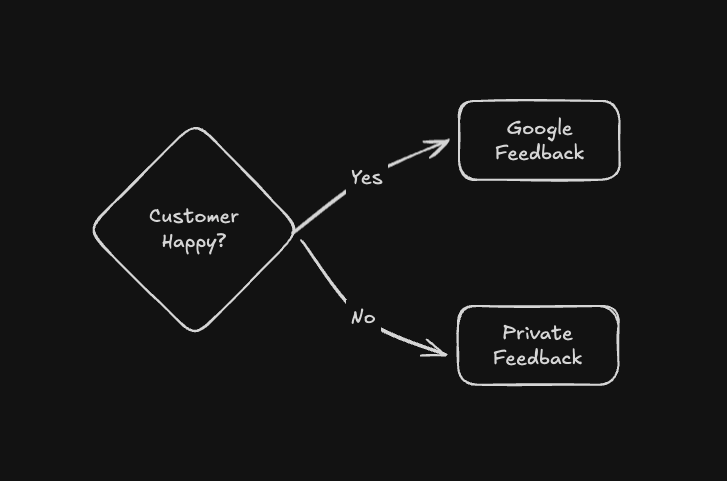
The consequences are severe. Fashion Nova paid $4.2 million in FTC fines for suppressing reviews with ratings below four stars. Under current FTC rules, violations can result in fines up to $51,744 per fake or manipulated review.
Google's algorithm has gotten smarter too. In May 2025, Google rolled out significant updates that use AI to detect suspicious review patterns, and businesses can face temporary review blocking and warning banners on their profiles.
What Compliant Review Filtering Actually Is
Here's where it gets interesting: You CAN ethically manage customer feedback—you just have to ask everyone for reviews equally.
Compliant filtering means:
- Asking ALL customers to leave a Google review (not just happy ones)
- ALSO offering unhappy customers a private channel to resolve issues
- Never preventing anyone from leaving a public review
Example of Compliant Filtering
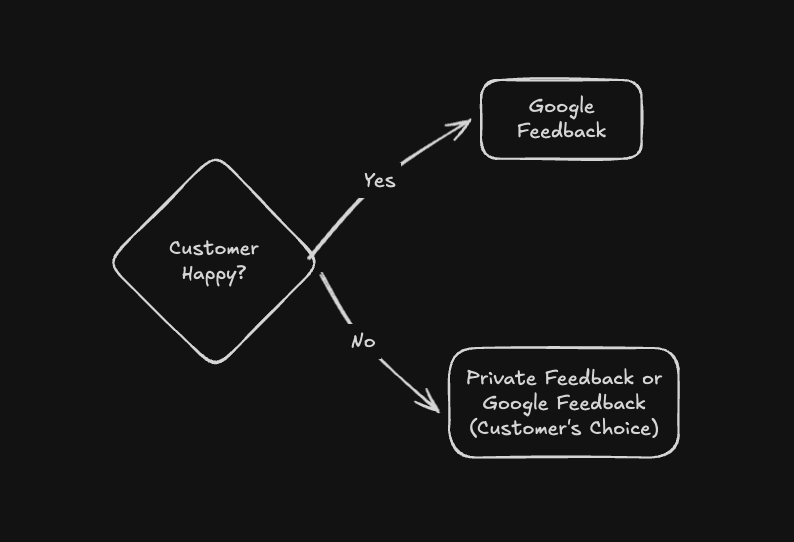
Google's 2026 compliance guidelines state you must ask every customer for a review, use natural language, never offer incentives, and let customers choose their own star rating.
Think of it like this: You're opening two doors, not closing one. Everyone gets the Google review option. Unhappy customers simply get an additional option to contact you directly first.
Why This Approach Works
Most unhappy customers want their problem fixed, not to write a bad review. Research shows 96% of customers specifically seek out negative reviews to understand potential drawbacks before purchasing—they know perfect ratings look suspicious.
When you give frustrated customers a private resolution path alongside the public review option, you're not manipulating anything. You're being helpful.
It's the difference between:
- ❌ "Rate us 5 stars HERE!" (only sent to satisfied customers)
- ✅ "Please share your honest feedback on Google. If something went wrong, we'd also love to make it right—contact us here."
The Real Risk: Google's 2026 Crackdown
Google is currently removing reviews at unprecedented levels, deleting over 240 million policy-violating reviews in 2024 alone. Their AI is now so aggressive that even legitimate reviews sometimes get filtered out if they appear in suspicious patterns.
Businesses are reporting reviews disappearing overnight, getting stuck in "pending" status, or never publishing at all. The system would rather delete 20 real reviews than let one fake review through.
This makes compliance more critical than ever. If Google detects gating patterns—sudden review spikes, identical wording, or suspicious filtering—your entire review history could be at risk.
The Bottom Line
Review filtering is ethical when it's actually customer service, not manipulation.
✅ Ethical and compliant:
- Ask all customers for reviews
- Offer unhappy customers an additional private feedback channel
- Never prevent anyone from leaving public reviews
- Respond professionally to all feedback
❌ Unethical and illegal:
- Only ask happy customers for reviews
- Block unhappy customers from review platforms
- Offer rewards for positive reviews only
- Suppress or hide negative feedback
The businesses that thrive aren't the ones gaming the system. They're the ones genuinely solving problems before they escalate. Tools that help you catch issues early—without preventing public reviews—aren't just compliant. They're good business.